For the First Time Again Tab

This is a complete guide to chord contruction with simple rules that broke me out of my playing rut. Y'all'll acquire how to construct chords using two methods, how to name chords, how chords relate to each other, simple rules to recall chords, and a lot more.
Purchase the PDF Version of this Lesson
This is a complete guide to chord contruction with elementary rules that broke me out of my playing rut. You lot'll learn how to construct chords using two methods, how to name chords, how chords relate to each other, simple rules to recall chords, and a lot more.
Why Chord Structure is Useful
When I was improvising for the beginning fourth dimension, I memorized scale patterns. This was so much fun because I could suddenly solo over a lot of chords and songs. The pattern made it easy, but I started to play the same licks over and over. I couldn't interruption this rut considering I didn't truly know the notes of the chords that I was playing over or the notes of the scale pattern that I was using. As a result, my playing became boring.
When I learned the chord tones, I was able to locate and play chord tones and call up musically. I didn't just larn the notes, I started to own the notes and make them work for me. This lesson covers everything y'all need to know almost chord structure along with my applied tips and intuition to make information technology like shooting fish in a barrel to acquire.
This lesson requires some knowledge of intervals. If y'all don't know them all the same, I recommend reading my intervals lesson. You should also know the major scale since it is used in ane of the 2 methods of chord structure. Yous can also find this information in Guitar Lesson Earth The Book.
Three Types of Chords
For practical purposes there are a three different types of chords that yous should know. I'grand not talking about chord qualities, rather I'm talking about categories of chords. These are triads, 7th chords, and extended chords.
Triads
Triads are 3 note chords. They can exist major, pocket-size, diminished, augmented, or suspended chords. Although triads are exactly iii notes, you tin can play major, minor, diminished, augmented and suspended chords with more than notes by but doubling some of the notes. All the CAGED chord forms that almost beginners learn utilize double notes.
Seventh Chords
These are four notation chords that accept a seventh degree, which is a note that is usually a major or pocket-size 7th interval higher up the root. The well-nigh common seventh chords are major vii, small 7, and dominant 7.
Extended Chords
Extended chords are only chords that contain a 9th, eleventh, or thirteenth. These are considered the extended notes. Yous should find that they could also exist considered the 2, four, or half-dozen. For example, in the fundamental of C, the 2d and 9th are both D. The 4th and 11th are both F. The 6th and 13th are both A.
You might be wondering why we fifty-fifty bother to use the names nine, eleven, thirteen, when 2, 4, and 6 are the same notes. There are a few reasons. The easiest reason is that nine, xi, and thirteen are used when you extend 7th chords. The highest degree of a seventh chord is the 7th, they are extended with higher numbered notes.
two Ways to Larn Chord Construction
At that place are two common ways that people teach chord construction. Each has their pros and cons. I like to teach both of them because they are both useful in their own mode.
Method 1: Formula + Major Scale
If you know the major scale, this is an easy approach.
- You lot choose a root annotation, such as C
- Yous go its major scale notes: C-D-E-F-G-A-B.
- Y'all use a chord formula from a listing, which I'll provide later.
For example, the chord formula for major chords is one-3-5. We take the first, third, and fifth note of the major scale to create this chord. So a C Major chord has the notes C-E-Thousand.
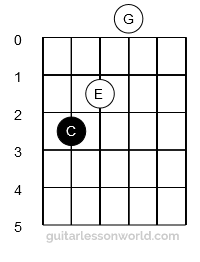
Some formulas modify 1 of the degrees with an adventitious. For case, the minor chord formula is 1-♭3-five. This ways that a C pocket-size chord has the notes C-E♭-G.
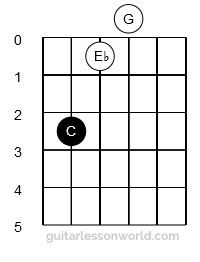
It is important to note that chords can double notes. For example, C Major in open up position doubles a C (2nd and fifth cord) and an Eastward (1st and quaternary cord).
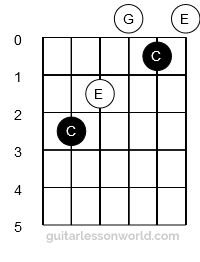
Because the major scale has 7 notes, you lot may exist wondering how nosotros play the extended chords, which include a nine, eleven, or 13. You simply repeat the notation names. For example, the notes of the C major scale (repeated) are C-D-East-F-G-A-B-C-D-E-F-K-A-B.
| 1 | ii | 3 | iv | 5 | vi | 7 | eight | 9 | x | 11 | 12 | 13 | 14 |
| C | D | East | F | G | A | B | C | D | Eastward | F | G | A | B |
Yous tin detect a listing of all the major scale notes and chord formulas in my resources section.
Method two: Intervals
Chords can be formed using interval formulas, which I will requite in a later section. These tin exist given as the interval from the root or relative to the previous note. If you lot demand to refresh your knowledge of intervals, I recommend reading my lesson on intervals.
Relative to the Root
If you are forming a C Major 7 chord with the root intervals, you would apply the following formula: major third, perfect fifth, major 7th.
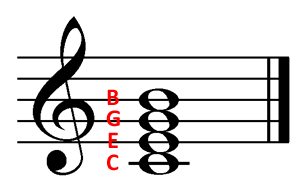
In other words, the notes are C (the root), E (a major 3rd upward from C), Chiliad (a perfect fifth upwardly from C), and B (a major seventh up from C).
Relative to the Previous Note
Sometimes intervals are specified relative to the previous notation because chords are (usually) stacked in thirds. For C major 7, the formula would be major tertiary, small third, major third. The notes are C (the root), E (a major third upwards from C), Thou (a minor third upward from E), and B (a major tertiary upwards from G).
Observe the alphabetic altitude betwixt the notes. C to E is a major third. It is a third because it spans three alphabetic note names C-D-Eastward. It is major because C and E are two full steps apart in pitch. E to G is a minor tertiary considering it spans 3 alphabetic annotation names, E-F-G, merely Due east and 1000 are only 1-i/2 steps apart. Knowing this volition help you lot place the pitches of the chord.
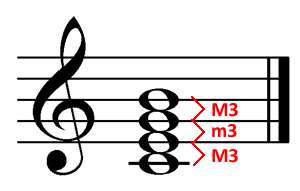
Some musicians say that chords are stacked in thirds because they are stacked i on pinnacle of each other on the staff, as shown above.
Knowing that most chords are stacked or spelled in thirds is useful and volition aid y'all place the notes and play more thoughtfully.
Chord Formulas
The following list provides the formulas. This probably covers 90% of the chords that you'll encounter. The others can exist derived with a working noesis of chord construction.
Triad Formulas
Most triads comprise a root, 3rd, and fifth. The suspended chords supervene upon the third with either the 2 or the 4. These chords are named using the 2 and 4 because they are replacing the 3rd rather than extending the chord. I will cover this in greater depth when we hash out extended chord formulas.
| Chord | Formula | Interval Formula | Audio |
| Major | 1-3-five | Root-M3-P5 | |
| Augmented | ane-3-♯5 | Root-M3-Aug5 | |
| Minor | 1-♭3-5 | Root-m3-P5 | |
| Diminished | 1-♭3-♭5 | Root-m3-dim5 | |
| Suspended 4 | 1-4-five | Root-P4-P5 | |
| Suspended 2 | one-two-five | Root-M2-P5 |
Seventh Chord Formulas
You may find a pattern hither. Seventh chords build upon triads. I listed the most common seventh chord formulas below. Take a minute to observe the triad to seventh chord human relationship. For example, Major 7 and Ascendant vii add a seventh to the major triad. Later in this lesson, I will give you some simple rules to help yous larn several chord patterns.
I often become asked almost the double-flat on the diminished seven chord. A double-flatted seventh is enharmonic with the half dozen. In other words, the pitch is exactly the same, but the proper name is different. It is named this way to go on the pattern of adding a 7th to a triad. For example, in the key of C, the 7th is B and ♭♭B is two semitones lower than B. It has the aforementioned pitch as A, which is the 6th note of the C major calibration (C-D-E-F-G-A-B).
| Chord | Formula | Interval Formula | Audio |
| Major 7 | one-iii-v-vii | Root-M3-P5-M7 | Coming Soon |
| Dominant 7 | i-3-5-♭7 | Root-M3-P5-m7 | Coming Soon |
| Minor seven | I–♭3–5–♭seven | Root-m3-P5-m7 | Coming Soon |
| Small-scale 7 Apartment 5 | I–♭three–♭5–♭seven | Root-m3-dim5-m7 | Coming Soon |
| Diminished 7 | I–♭3 –♭5–♭♭seven (or 6) | Root-m3-dim5-dim7 | Coming Presently |
Extended Chord Formulas
Below are some common extended chords. Their usefulness varies by style. Jazz musicians often start with the seventh chords, and add the extended chords over time. Blues musicians oft acquire the dominant ix chord right away. Meanwhile, Stone and Popular styles employ them occasionally, but you tin can become a long fourth dimension without learning them.
Yous will notice that the extended chords build upon the 7th chords in the same way that the 7th chords congenital upon the triads. Because we're building upon the previous chords, nosotros are ascending in order. Therefore, we start to use the "extended" names of ninth, 11th, and 13th instead of 2d, 4th, and 6th.
You will notice that the ascendant thirteen chord has 7 notes when the guitar only has 6 strings. Some notes will be omitted when you play this chord past yourself, but another ring member may play the notes that y'all omit.
| Chord | Formula | Interval Formula | Audio |
| Major ix | ane-3-5-vii-9 | Root-M3-P5-M7-M9 | Coming Soon |
| Dominant nine | 1-3-5-♭7-9 | Root-M3-P5-m7-M9 | Coming Presently |
| Dominant 11 | 1-3-5-♭7-9-11 | Root-M3-P5-m7-M9-P11 | Coming Soon |
| Dominant 13 | one-3-v-♭7-9-11-xiii | Root-M3-P5-m7-M9-M13 | Coming Shortly |
Quick Review
- I promised a practical approach to chord construction… we're non there yet!
- In that location are 3 main types of chords: triads, seventh chords, and extended chords.
- You can course a chord past using a formula based on the major scale or on intervals.
- Chords are congenital on thirds (we'll come back to this afterward).
Easy Ways to Remember Chord Formulas
This is where the practical arroyo begins. Allow'south first with some common observations.
Three Observations
- All chords except the suspended chords contain a root, third, and fifth. Suspended chords supervene upon the third with a second or 4th.
- Chords skip notes. In other words, 1 (skip two) 3 (skip 4) , five, (skip 6), 7, etc. In notes: C, (skip D), Eastward, (skip F), 1000, (skip A), B. And then the notes are C, E, Grand, B (for C Maj 7)
- I omitted power chords because they merely incorporate 2 notes, the root and perfect fifth. The C ability chord is notated as C5 and contains the notes C and G.
7 Rules to Derive the Chord Formulas
These rules are useful considering they tell you the important notes for each chord quality! You can also form almost whatsoever chord with these rules.
How Chord Names Relate to 3rds, 5ths, and 7ths
- Major and dominant chords all take a major third (3)
- Minor and diminished chords all have a minor third (♭3)
- Major seven chords have a major 7th (7)
- Minor 7 and ascendant chords have a pocket-size seventh (♭vii) [in add-on to the minor third (♭3)]
- Diminished chords accept a macerated 5th (♭5) [in addition to the minor tertiary (♭3)]
- Augmented chords have an augmented fifth (♯5)
- Suspended chords replace the tertiary with a major 2nd (2) or perfect fourth (4)
seven Rules in Table Format
| Chord | 3 rd | 5 th | 7 thursday |
| Major & Dominant | three | ||
| Pocket-sized | ♭3 | ||
| Major 7 | seven | ||
| Minor seven & Ascendant 7 | ♭7 | ||
| Macerated | ♭iii | ♭5 | |
| Augmented | 3 | ♯5 | |
| Sus2 | 2 | ||
| Sus4 | 4 |
Tip: Jazz musicians often focus on the 3rd and 7th of the chord. They are important chord tones that you tin highlight when improvising.
Chord Modifiers
The chord formulas in a higher place comprehend many of the chords you lot'll need to know. The following modifier rules will help you modify them to learn almost all the rest.
- Add chords– These are chords that just add a note. For case, a Cadd9 chord is a C Major chord with an added 9th (D). Considering it doesn't have a seventh, it is non a ninth chord. For 9th chords, y'all need the entire sequence of root, 3rd, fifth, seventh, ninth.
- Omit chords – These chords just omit a notation from the chord. Chords are oft played with omitted notes, merely it is rarely specified. When it is, the composer is stressing the demand to omit that note.
- Modified Notes – You may come across chords with a modified note. Some examples include minor7♭5, which is pronounced pocket-sized seven flat five. It is just a minor7 chord with a flatted fifth. Another example, is a modified add chord like the dominant7♯9 chord. It is simply a dominant 7 chord with an added and sharped ninth. E7♯nine or E7(♯9) is sometimes called the Hendrix chord.
Quick Review 2
Before the REALLY applied part of this lesson, let'due south review.
- Chords are generally constructed in thirds, which skip every other annotation.
- There are some easy rules that help musicians construct and think of the chord's harmony.
- The tertiary and seventh are important chord tones.
- Added, omitted, or modified notes tin can be specified in the chord'south name.
Practical Chord Construction Secrets
At this point, some teachers would instruct you to memorize several chords or stop here and allow you learn chords as you need them to play a song. Neither approach is wrong, only they don't give y'all intuition or simplified rules to improve your playing. In this department, I will reveal some simple rules that teach y'all how almost guitar chords are constructed. Information technology will help y'all think faster and play thoughtfully with specific notes in mind.
The Great Grip Trouble
Chords on the piano are often played in an orderly fashion. In other words, the lowest note is the root, the adjacent pitch is the 3rd, followed past 5th. It's all neat and tidy. This guild, still, is not required. Actually, guitarists rarely play the notes in this order because it is difficult to grip them unless you alter the order. Let's take a look at C7 rooted on the 6th string. The first grip keeps the notes in club like a pianist would play it. The 2d grip changes the social club of the notes to make information technology easier to play on the guitar.
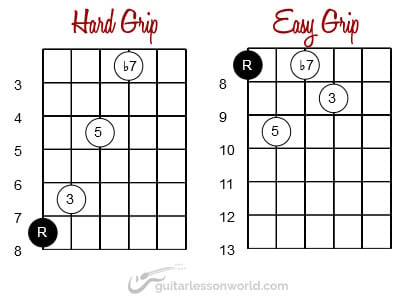
In standard tuning, playing chords similar a pianist is impractical, and then guitarists usually play different voicings. In guitar terms, voicings are different grips for the aforementioned chord. In more precise terms, a voicing determines the gild of the notes along with which notes are doubled.
Inversions
Chord voicings that change the order of the notes are often chosen inversions. For instance, your base triad is R-3-5. The commencement inversion of this chord orders the notes every bit 3-5-R. The 2d inversion would gild the notes as 5-R-3. This lesson volition not teach you several inversions of chords, but it is good to know. You lot can derive several chord grips by trying to observe all the combinations. I volition explore this in a future lesson, but I will give you some practical advice on forming chords with easier grips in the next couple of sections..
Solving the Great Grip Problem
The dandy grip trouble exists because we use standard tuning, which means that our guitar is tuned in perfect fourths except between the 2d and 3rd cord where the interval is a major third. You learned earlier that chords are built in thirds (or that they skipped notes). When y'all desire to play a third on the next string, y'all demand to move to a lower fret about every fourth dimension. As you add thirds, the grip becomes harder and harder. For example, R to iii spans 2 frets. When y'all add together the 5th, the chord spans iv frets. When yous add the flatted seventh, the chord spans half dozen frets. Information technology is difficult to stretch your fingers across 6 frets.
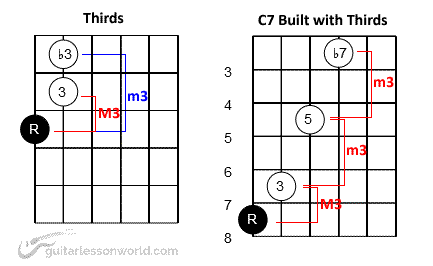
Chords are congenital in thirds which forcefulness you to movement to lower frets on each string. We need to find a style to move forward!
The 45 Split up
The fundamental to constructing not bad chords is to alternate between notes that move you up and down the fretboard. So far, we know that thirds move us backward, only what moves u.s.a. forward? Information technology is simply a college interval, and the side by side chord tone after the tertiary is the 5th. The diagram below shows the root note and the notes on the next college string. Notice how the thirds move yous back but the 5th moves you lot forwards.
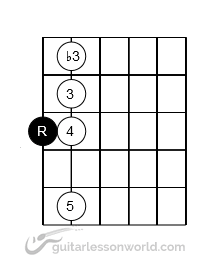
The dividing line betwixt moving backwards and forward is what I phone call the 45 divide. I named it that way because of how it helps yous discover notes from a chord formula. The notation on the same fret as the root annotation just on next college string is a perfect 4th. The note on the aforementioned fret as the root note but on the adjacent lower cord is a perfect fifth (for chord formula purposes). Since it is a fourth one way and a fifth the other, I telephone call it the 45 separate.
For example, sus4 chords contain a root, perfect 4th, and perfect 5th. Csus4 contains C (root), F (4th), and G (5th). If you play C on the 3rd fret of the 5th string. Y'all will find an F on the tertiary fret of the 4th string and a G on the 3rd fret of the 6th cord.
Be careful when moving between the third and second strings, they're divided by a 36 dissever instead (Major 3rd ascending, small-scale 6th descending). If you aren't sure why, look at how the guitar is tuned or contact me for clarification.
The Complete 45 Carve up
The consummate 45 carve up is simply the chord tones inside three frets of the root's fret. Let'south take a look when we're rooted on the 6th cord. I included flatted thirds and sevenths since they're so common. Notice how yous can detect E-form and M-form chords in the post-obit diagram. There are other diagrams that are rooted on different strings and correspond to the other CAGED forms.
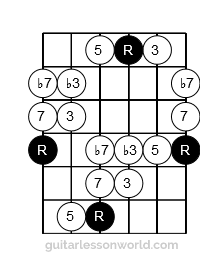
The goal of this diagram is to requite you a quick reference of the chord tones.
2 Applied Formulas for the Most Common Chords
Allow'south take a wait at how the pop CAGED chord forms are synthetic. You lot'll see similar patterns.
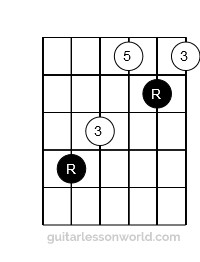
East-Form, A-Form, D-Course: R-5-R-three-(5)-(R)
Find how the following chords all start with the root note, so the 5th, repeat the root, then play the third. This is a very common pattern in guitar chords. I label this form R-5-R-3-(5)-(R). Optional notes are shown in parentheses.
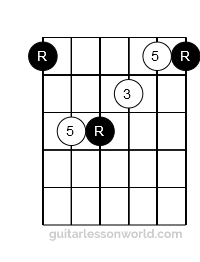
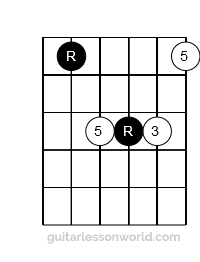
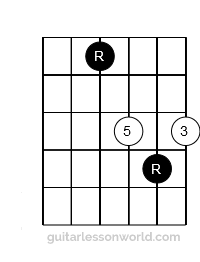
The E, A, and D Course chords apply the same pattern. They simply start on a different string!
C-form, M-form: R-iii-5-(R)-(3)-(R)
The C and Thousand form both play with the root, tertiary, 5th, and so echo the root. They use the same pattern: R-iii-5-(R)-(three)-(R). Once once more, optional notes are in parentheses.
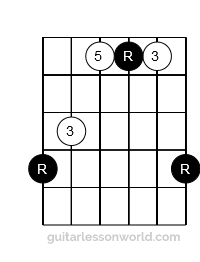
Like the The C and M Form share the same interval pattern. They simply start on a different string.
Forming Seventh Chords with Modifications
We can hands modify these chords to form seventh chords! Usually, this is done by modifying doubled notes or the fifth, which is sometimes omitted.
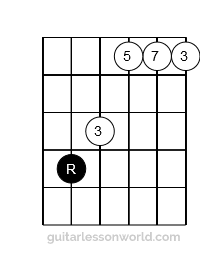
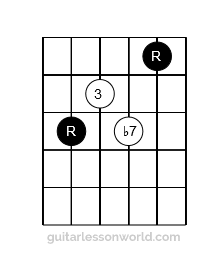
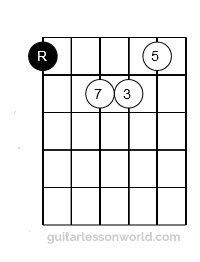
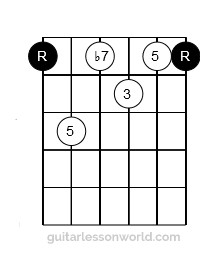
Forming Extended Chords with Modifications
Extended chords are usually formed past modifying a doubled notation or one that we consciously omit. Below are examples of a dominant 9 and a ascendant 13 chord.
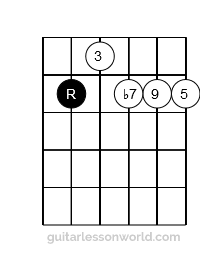
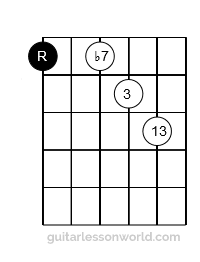
Practical Chord Construction Rules
Now let's review what nosotros just learned and so learn a few extra rules.
Ii Common Forms
Most mutual chords are based on the following forms.
- R-5-R-iii-(5)-(R) – Used in the E, A, and D chord forms
- R-three-five-(R)-(3)-(R) – Used in the Chiliad and C chord forms.
Common Modifications to Construct Seventh Chords
- Supervene upon doubled roots with sevenths.
- Omit or modify fifths, normally to play a seventh instead.
Chords that skip strings normally skip the string later the everyman notation.
Common Modifications to Construct Extended Chords
We know that nosotros tin can't always play every annotation in an extended chord. We try to change doubled notes get-go, but often nosotros have to brand a compromise. Usually it is using the post-obit rules.
- Replace a root to create a 9th chord.
- Replace a fifth to create an 11th or 13th chord.
String to String Motility
You will notice that the following rules use to nigh all guitar chords when switching from a lower pitched string to a higher pitched string.
- The root either descends to the 3rd or ascends to the 5th
- The third either descends to the 5th or ascends to the 7th
- The fifth either descends to the 7th or ascends to the root
- The 7th either descends to the root or ascends to the third.
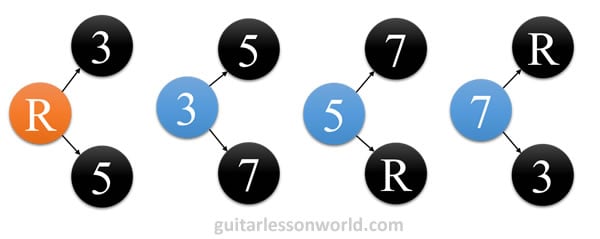
It can be simplified to an fifty-fifty simpler and more powerful rule:
Whatsoever interval descends to the adjacent interval or ascends to the interval after that.
Practicing to Learn Chord Tones
Everything you learned in this lesson was intended to give yous intuition and simplify the many rules. Regardless, it is still a lot of information. You lot nonetheless need to practice this and so you don't forget it. Here are some practicing recommendations.
What to Practice
Below is a list of what to practice in the order that I recommend.
- Acquire the triads chords outset: major, small
- Acquire the seventh chords next: major vii, minor seven, and ascendant 7
- Learn diminished and minor vii♭5
- Learn suspended chords
- Learn augmented chords.
- Larn extended chords.
How to Do
I recommend using the 3-3 rule. In a given week (or vii-day span), practice 3 exercises at to the lowest degree 3 days. Continue practicing until you truly learn the chords.
- Play the diatonic sequence in mutual keys. For case, in the central of C, play C, Dm, Em, F, Yard, Am Bdim. Then play it with seventh chords: CMaj7, Dm7, Em7, FMaj7, G7, Am7, Bm7♭5.
- Play the diatonic sequence chords, but go upward a 5th then down a fourth. For example, play C, G, Dm, Am, Em, Bdim, F, C. You tin can play this sequence with one class (such as Due east-form) and move information technology around or you can try to stay in the aforementioned position.
- Play one chord upwardly the fretboard using the CAGED forms. For example, play C-course, then A-form, G-grade, E-class, and D-class. If one is hard to play, look for variations at the same position. Usually the Chiliad-course is hard to play, but you normally accept an option on strings 1-4.
- Practice improvising over a chord progression past playing chord tones from the shapes that yous know.
- Although I didn't explain it here, you can play arpeggios and try to visualize the chord shapes that you are playing.
- Larn sets of chords, such equally Drop 2, Drop 3, and Drop 2&four. These will provide several combinations of chords.
As you modify chords, listen for the differences in the chord sounds. Besides, look at the differences in the grips. The goal is to learn the notes you are playing.
Determination
Ironically, learning chord construction helped me improvise better. I was able to sympathize the notes that I was playing. It helped me link melody to harmony effectively. Information technology truly broke a estrus for me, and it can do the same for you.
I am planning several new lessons that expand on this lesson. My Drop-2 chords lesson is a skillful follow-upwards lesson because it covers several combinations of chords.
This was a huge lesson. If you read this far, you lot must be a future guitar hero, but I desire to thank you for reading it. I truly hope it helps you lot amend.
If you liked this lesson, please consider buying the PDF version to support content like this. Alternatively, the biggest thanks I can get is for you to like my facebook folio and exit a mail with what yous liked nigh information technology. As e'er, feel gratis to contact me with your questions, concerns, etc. I am here to help!
Buy the PDF Version of this Lesson
Source: https://www.guitarlessonworld.com/lessons/chord-construction/
0 Response to "For the First Time Again Tab"
Post a Comment